Cake and Jello Recipe – Easy Homemade Dessert in 15 minute
Table of Contents
Most home bakers think a poke cake is just a regular sheet cake with holes poked in it. That’s technically true, but it misses the entire magic. The real trick is what happens after the holes go in: when you pour warm jello into those gaps and it gets absorbed, you’re not just adding moisture. You’re creating a texture gradient that shifts from dense cake at the edges to creamy, gel-soaked center to fluffy frosting on top. A jello poke cake recipe is really three desserts stacked into one, and when you nail the technique, your guests will taste the difference immediately.
The strawberry and vanilla version is the crowd favorite for a reason. It’s forgiving, visually stunning, and tastes like summer no matter the season. Let’s build this from the ground up so you understand not just the steps, but why each one matters.
What Makes A Poke Cake Different From Regular Cake?
A standard sheet cake sits on a plate, gets frosted on top, and that’s it. A cake and jello gets punctured all over the surface, then you pour liquid (usually jello) directly into those holes. The liquid soaks down, gets absorbed by the cake crumb, and creates pockets of flavor and moisture that a normal cake simply cannot achieve.
The structural contrast is what separates a cake and jello from a regular frosted cake. You get the dry, tender crumb of baked cake on the outside. You get the gel-soaked, almost pudding-like texture in the middle. And you get the cool, fluffy frosting on top. Three distinct textures in every bite. A regular cake? Uniform crumb throughout, frosting on the outside. Done.
This method also solves a problem that has plagued home bakers forever: how to keep a cake from drying out by the next day. Sheet cakes left uncovered go stale fast. A poke cake, sealed with frosting and chilled, stays moist for days because the jello acts as a moisture barrier and a flavor carrier. The cake doesn’t just taste fresher. It tastes intentional.
How Does Jello Soak Into Cake?
When you poke holes in a warm cake and pour warm jello into those gaps, the gelatin liquid flows down through the crumb structure. The cake is still warm, so it’s more porous. The jello hasn’t fully set yet, so it’s still liquid. Those two facts working together mean the jello soaks down fast and deep, much faster than it would if you poured it on a cold cake.
The holes themselves are the delivery system. Without them, jello would just sit on top of the cake and slide off the sides. With them, the jello has a direct path into the cake’s interior. The spacing and depth of the holes matter enormously. Holes too shallow, and the jello doesn’t penetrate the center. Holes too close together, and you risk compromising the structural integrity of the cake. Holes spaced too far apart, and you get dry pockets between them.
Timing is the secret variable most recipes skip over. If you pour jello that is still too hot, it can break down the cake structure and make the whole thing mushy. If you wait until the jello is already gelling, it won’t flow into the holes properly. The sweet spot is when the jello is warm but no longer steaming, usually 5 to 10 minutes after you mix it with hot water. You want it pourable, not runny.
Why Choose Jello Over Other Glazes?
You could pour a sugar syrup into a poke cake. You could use fruit juice. You could use pudding. But jello has advantages that none of those alternatives can match.
First, flavor variety. Jello comes in dozens of flavors, and you can layer them if you want. A sugar syrup is just sugar. Juice is one-note. Jello gives you a flavor experience that actually complements the cake, not just adds sweetness.
Second, texture. Jello sets into a gel that is cool, slightly firm, and stays that way when refrigerated. A syrup stays liquid and can make the cake soggy if you’re not careful. Pudding is thick and heavy. Jello is light, refreshing, and adds moisture without weight.
Third, visual appeal. You can see the jello through the frosting if you leave gaps. You can layer different colors. You can add fruit to the jello before it sets. A clear glaze or syrup doesn’t offer that visual dimension. Jello is a dessert you eat with your eyes first.
Finally, cost. A box of jello costs less than a dollar. The other options require more ingredients or more specialty products. You can make a stunning dessert for a crowd for pennies per serving.
Essential Ingredients For Strawberry Jello Poke Cake
A basic poke cake needs five things: cake, jello, liquid, frosting, and toppings. Let’s break down what each component should be and why it matters.
For the cake itself, you can use a box mix or bake from scratch. A box mix is faster and more forgiving. A from-scratch cake gives you more control over the crumb density. For this guide, we’ll assume you’re using a box mix because that’s what most home bakers reach for, and it works beautifully. A white or vanilla cake mix is the standard base. You will need one 15.25-ounce box.
The jello is the star. You need one 3-ounce box of strawberry jello (or whatever flavor you choose). That’s the standard packet size you find in any grocery store. You will dissolve this in 1 cup of boiling water, then add 1/2 cup of cold water to cool it slightly before pouring.
For frosting, you need one 8-ounce tub of whipped topping (like Cool Whip) or you can make homemade whipped cream. Some recipes call for a cream cheese frosting, which is richer. We’ll cover the differences in a later section.
Fresh strawberries are optional but highly recommended. They add texture, flavor, and visual pop. You don’t need a huge quantity. A pint of fresh strawberries is enough to garnish a 9-by-13-inch cake.
The cake mix ingredients are straightforward: 1 cup water, 3 large eggs, and 1/3 cup vegetable oil. Some recipes call for slightly different ratios, but these are the standard amounts that come on the back of most cake mix boxes. Use room-temperature eggs. Cold eggs don’t incorporate as smoothly.
What Type Of Jello Works Best?
The powdered gelatin that comes in those 3-ounce boxes is the standard. It’s pre-sweetened, pre-flavored, and designed to set at a specific rate. That consistency is important for a poke cake because you need the jello to set firm enough to hold its shape, but not so firm that it becomes rubbery.
You could use unflavored gelatin powder and add your own flavoring, but that’s more work and more variables. Stick with the flavored packets. They’re reliable and they’re cheap.
Flavor pairings matter. Strawberry with vanilla cake is the classic for a reason. It’s bright, not too heavy, and the flavors don’t fight each other. But you can experiment. Raspberry jello with chocolate cake is stunning. Lime jello with coconut cake is tropical and refreshing. Orange jello with white cake feels summery. The rule is: pick flavors that complement the cake, not compete with it.
If you have dietary restrictions, there are alternatives. Agar-agar is a plant-based gelling agent that works similarly to gelatin. Sugar-free jello exists and sets the same way as regular jello. You can even use fruit juice that has been thickened with cornstarch, though the texture won’t be identical. The key is maintaining the gel consistency so the cake doesn’t become a soggy mess.
Can You Use Fresh Fruit With Jello Cake?
Yes, and it transforms the dessert. Fresh strawberries on top are the most common choice, but you can layer fruit inside the jello before it sets.
If you want to embed fruit in the jello layer, slice your strawberries thin and arrange them in the cake pan before you pour the jello. As the jello sets, the fruit stays suspended and creates a beautiful pattern when you slice the cake. Use fruit that won’t release too much liquid. Strawberries and raspberries work. Peaches and pineapple can be watery.
Fresh fruit on top should be added right before serving or no more than 2 hours before, because fruit releases moisture and can make the frosting weep. Slice strawberries lengthwise so they look elegant. Arrange them in a pattern on top of the frosting.
Frozen fruit is a different story. You can use frozen strawberries if fresh aren’t available, but thaw them completely and pat them dry, because excess moisture will ruin the frosting. Frozen fruit that is still icy will crack your frosting when it touches the cold surface.
How Do You Make Jello Poke Cake Step-By-Step?
The process is straightforward, but the details matter. Here is the exact sequence.
First, bake your cake according to the box directions. Use a 9-by-13-inch baking pan. Bake at 350 degrees Fahrenheit for the time specified on the box, usually 28 to 32 minutes. The cake is done when a toothpick inserted in the center comes out with a few moist crumbs, not wet batter. Remove the cake from the oven and let it cool for 10 minutes in the pan. This is important. If you poke holes in a cake that is still too hot, the crumb is fragile and tears easily.
While the cake cools, prepare your jello. Boil 1 cup of water. Pour it into a bowl with the jello packet. Stir for 2 minutes until the jello is completely dissolved. No lumps. Add 1/2 cup of cold water and stir again. The mixture should still be warm but no longer steaming. This temperature is crucial. You want it warm enough to flow into the holes, but cool enough that it won’t break down the cake crumb.
Once the cake has cooled for 10 minutes, it’s time to poke. Use a fork, a toothpick, or a wooden skewer. A fork works fine for most home bakers because the tines create multiple small holes at once. Press the fork straight down into the cake, spacing the holes about 1 inch apart in a grid pattern. You should poke holes all over the top surface, creating roughly 50 to 100 holes depending on the size of your fork. Don’t poke too hard. You want to create an opening, not destroy the cake structure.
Now pour the jello slowly over the entire surface of the cake. Pour it in a thin stream, letting it soak in as you go. This takes 2 to 3 minutes. Don’t rush. If you pour too fast, the jello will overflow the sides and you’ll waste it. If you pour too slow, the jello on the edges will start to gel before you finish pouring. Steady, slow, deliberate.
Once all the jello has been poured, let the cake sit at room temperature for 15 minutes. Then transfer it to the refrigerator. Chill for at least 2 hours, but ideally overnight, before adding frosting. The longer the jello has to set, the better the texture will be.
How Deep Should You Poke The Cake?
The holes should go about three-quarters of the way down into the cake, not all the way to the bottom. If you poke all the way through, the jello will leak out the bottom. If you don’t poke deep enough, the jello won’t penetrate the center of the cake.
A fork naturally creates shallow holes. A wooden skewer creates deeper holes. For a standard 9-by-13-inch cake that is about 1.5 inches tall, you want holes that are about 1 inch deep. That leaves a quarter-inch of cake at the bottom as a seal.
Spacing matters too. Holes that are too far apart leave dry pockets in the cake. Holes that are too close together create a weak structure. One inch apart is the sweet spot. Imagine a grid where each hole is at the corner of a 1-inch square. That’s your target.
A fork is the easiest tool for most home bakers. A wooden skewer gives you more precision if you want to poke deeper. Toothpicks work but are tedious because you have to make individual holes. A fork is faster and more forgiving.
What’s The Right Temperature For Jello Pour?
This is where most home bakers fail. They either pour jello that is too hot, which breaks down the cake, or too cold, which doesn’t flow into the holes properly.
The jello should be warm to the touch but not hot. If you can hold your finger in it for 5 seconds without pulling away, it’s the right temperature. This usually happens 5 to 10 minutes after you mix the jello with hot water and cold water.
If the jello is still steaming, wait. If it’s already starting to gel (it will look slightly thicker and less liquid), you waited too long. You need to reheat it gently in the microwave for 15 to 20 seconds and try again.
The reason temperature matters is that warm jello flows into the holes and soaks into the cake crumb. Cool jello that is starting to gel will sit on top of the cake and pool instead of soaking in. If that happens, you get a jello layer on top instead of jello distributed throughout the cake.
How Long Does Cake With Jello Need To Chill?
Minimum two hours. But overnight is better.
The jello needs time to set completely. It will look set after 2 hours, but the interior will still be slightly soft. Overnight chilling (8 to 12 hours) ensures that the jello is completely firm throughout, and the cake has absorbed all the liquid it’s going to absorb. The texture becomes more uniform and more stable.
You can add frosting after 2 hours if you’re in a rush, but the frosting will be easier to apply and will look better if you wait until the jello is completely set. A warm cake or partially set jello will cause the frosting to melt or slide.
Once the jello is set, the cake can stay in the refrigerator for up to 4 days before you frost it. The jello acts as a moisture barrier, so the cake won’t dry out.
Can You Layer Multiple Jello Flavors In Poke Cake?
Yes, and this is where poke cake gets fun. You can create a multi-layered dessert with two, three, or even four different jello flavors, each one creating a distinct stripe in the cake.
The technique is simple but requires patience. You poke holes in the cake, pour the first jello flavor, and let it set completely in the refrigerator. Once it’s firm, you poke a second set of holes (in the gaps between the first set, or at a slight angle), pour a different jello flavor, and let that set. Repeat for additional layers.
The key is waiting for each layer to set completely before adding the next. If you don’t, the jello flavors will mix and you’ll end up with a muddy color and blended flavors instead of distinct layers. Completely set means 4 to 6 hours in the refrigerator, not just 2 hours.
This method takes time, so plan ahead. A three-flavor poke cake needs at least 12 to 16 hours of chilling time, spread across multiple layers. It’s worth it for special occasions, but it’s not a quickie dessert.
Which Jello Flavors Pair Well Together?
Think about flavor combinations that already work in desserts. Strawberry and vanilla is the classic. Strawberry and lemon is bright and fresh. Strawberry and raspberry creates a berry medley. Lime and coconut is tropical. Orange and vanilla feels summery.
The rule is: complementary flavors, not competing ones. Don’t layer cherry and lemon because they fight each other. Don’t layer two berry flavors that are too similar, like strawberry and raspberry, because they’ll blend into one muddy color.
Color contrast is also important. Strawberry is red. Lime is green. Orange is orange. These colors are visually distinct. Lemon and orange are both yellow-ish, so they won’t look as dramatic when layered. If you want visual impact, choose flavors with different colors.
How Do You Prevent Jello Layers From Mixing?
The answer is complete gelation. Each layer must be completely set and firm before you add the next layer.
Temperature control is part of this. Keep your refrigerator at 40 degrees Fahrenheit or below. A warmer fridge will cause jello to set more slowly, and you risk the layers mixing.
Timing is the other part. Don’t try to speed this up. Wait the full 4 to 6 hours between layers. If you pour a second jello layer before the first one is completely firm, the heat of the warm jello will start to melt the layer below, and they will mix.
One trick: you can poke the holes for the second layer at a slight angle (45 degrees instead of straight down) so the new jello travels to a different part of the cake and doesn’t directly hit the layer below. This reduces the chance of mixing even if the timing is slightly off.
What’s The Best Frosting For Jello Poke Cake?
You have three main options: whipped topping (like Cool Whip), homemade whipped cream, or cream cheese frosting. Each one has a different texture and flavor profile.
Whipped topping is the easiest and the most stable. It comes pre-made, it doesn’t melt as quickly as whipped cream, and it’s forgiving to work with. The downside is that it’s not as flavorful as the other options. It’s mostly air and stabilizers. It tastes good, but it tastes like whipped topping, not like a carefully crafted frosting.
Homemade whipped cream is made from heavy cream and sugar, whipped until stiff peaks form. It’s more flavorful than whipped topping and feels more luxurious. The downside is that it melts faster, especially if your kitchen is warm. You need to work quickly and keep the cake refrigerated at all times. Homemade whipped cream is best for cakes that will be served immediately.
Cream cheese frosting is made from cream cheese, butter, powdered sugar, and vanilla. It’s rich, tangy, and delicious. It pairs especially well with berry jello flavors. The downside is that it’s heavier than the other options and can overpower the lightness of the jello layer. Save cream cheese frosting for when you want a more decadent dessert.
For a strawberry jello poke cake, whipped topping or homemade whipped cream are both excellent choices. They’re light enough to let the jello flavor shine through, and they complement the strawberry without competing.
Should Frosting Go On Before Or After Chilling?
Always after. The jello must be completely set before you add any frosting.
If you frost before the jello is set, the weight and warmth of the frosting will cause the jello to soften or melt. The frosting will slide around on top of the cake, and you’ll end up with a mess.
Wait until the jello has chilled for at least 2 hours, but ideally overnight. Then remove the cake from the refrigerator, apply the frosting, and return it to the refrigerator immediately. If you’re using whipped cream, work as quickly as possible because it will start to melt at room temperature.
If you’re using whipped topping, you have a bit more flexibility. You can frost the cake and then leave it at room temperature for 30 minutes to an hour without the frosting melting. But it’s still best to keep it refrigerated.
How Can You Make Frosting Decorative?
Piping is the classic technique. Transfer your frosting to a piping bag with a large star tip. Pipe rosettes or swirls across the top of the cake. This looks elegant and professional and takes only a few minutes once you get the hang of it.
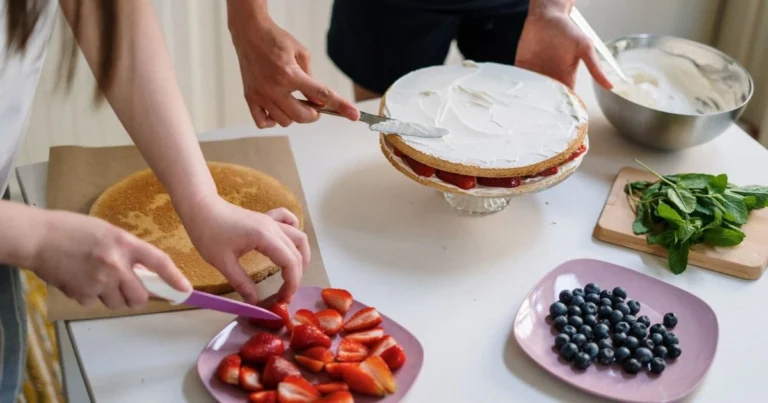
Fresh fruit is the easiest garnish. Slice strawberries lengthwise and arrange them in rows or a pattern on top of the frosting. You can also arrange whole berries, or a mix of strawberries and raspberries for color variety.
Jello cubes are a fun touch. Make extra jello in a shallow pan, let it set, then cut it into cubes and scatter them on top of the frosting. This adds color, texture, and a visual callback to the jello inside the cake.
Sprinkles work too, though they’re less elegant. A light dusting of colored sprinkles or pearl sugar adds a festive touch if you’re making this for a party.
How Should You Store Cake With Jello Filling?
A jello poke cake is a refrigerator dessert. It cannot sit at room temperature for more than 2 hours without the frosting starting to melt and the jello starting to soften.
Store the cake in an airtight container in the refrigerator. A cake box works, or a large plastic container with a lid. If you’re storing it without a lid, cover it loosely with plastic wrap or foil so it doesn’t absorb odors from other foods in the fridge.
The cake will stay fresh and moist for 3 to 4 days in the refrigerator. After that, the frosting may start to weep slightly, and the jello may begin to break down. The cake is still safe to eat, but the texture won’t be as good.
Can You Freeze Jello Poke Cake?
Freezing is possible, but it’s not ideal. The jello will become icy and the frosting will separate slightly when thawed. The cake won’t have the same texture as a freshly made one.
If you must freeze, do it before you frost the cake. Let the unfrosted cake freeze solid (at least 8 hours), then wrap it tightly in plastic wrap and foil. It will keep in the freezer for up to 2 weeks.
To thaw, move the cake to the refrigerator and let it thaw completely, which takes 6 to 8 hours. Then frost it and serve. The texture won’t be quite as good as a cake that was never frozen, but it will still be delicious.
Don’t freeze a frosted cake. The frosting will separate and slide off the cake as it thaws, and the presentation will be ruined.
How Long Does This Recipe Stay Fresh?
Three to four days in the refrigerator, maximum. After that, the jello may start to break down and the frosting may weep.
Signs of spoilage include a sour smell, mold on the frosting or fruit, or a slimy texture to the jello. If you see any of these signs, throw the cake away.
Food safety guidelines say that any cake with dairy frosting (whipped cream or cream cheese) should not sit at room temperature for more than 2 hours total. If your kitchen is warm, reduce that to 1 hour. Once you bring the cake inside from a party or event, refrigerate it immediately.
Common Mistakes When Making Jello Cake
Most failures fall into a few predictable categories. Understanding what goes wrong helps you avoid it.
Why Is Your Poke Cake Too Soggy?
Sogginess usually comes from one of three sources: too much jello, not enough chill time, or the wrong cake density.
If you pour more than the recipe calls for, the cake will absorb more liquid than it can handle and become mushy. Stick to the measurements. One 3-ounce box of jello dissolved in 1 cup boiling water and 1/2 cup cold water is the standard ratio. Don’t improvise.
If you don’t chill the cake long enough before frosting, the jello is still too soft and will continue to weep liquid into the cake. Wait the full 2 hours minimum, and ideally overnight.
A dense, heavy cake absorbs more liquid than a light, fluffy cake. If you use a box mix and follow the directions, you’ll get a cake that is light enough to absorb the jello without becoming soggy. If you use a homemade cake, make sure it’s a tender crumb cake, not a dense pound cake.
What If Your Jello Didn’t Set Properly?
If your jello is still soft after 4 hours in the refrigerator, something went wrong with the gelation process.
The most common cause is using the wrong ratio of water to jello powder. If you added too much water, the jello won’t set firm. The standard is 1 cup boiling water and 1/2 cup cold water per 3-ounce box. Don’t deviate.
Temperature issues can also cause this. If your refrigerator is too warm (above 40 degrees Fahrenheit), jello will set much more slowly. Check your fridge temperature with a thermometer.
If you poured the jello when it was too hot, it may have broken down some of the gelatin. Wait until the jello is warm but not steaming before pouring.
If your jello still hasn’t set after 8 hours, dissolve a new box of jello and pour it on top of the old layer. The fresh jello will set properly, and you’ll have a double-thick layer. It’s not ideal, but it saves the cake.
Variations To Try Beyond Strawberry Jello Poke Cake
Once you master the basic strawberry and vanilla version, you can experiment with other flavor combinations. The technique stays the same. Only the flavors change.
How Do You Make Coconut Lime Jello Poke Cake?
Use a white or vanilla cake mix as the base. Substitute lime jello for strawberry. Use 1 cup of sweetened coconut milk instead of the 1/2 cup cold water when you make the jello. This adds coconut flavor directly into the jello layer.
Top the cake with whipped cream frosting and garnish with toasted coconut flakes and fresh lime zest. The result is tropical, refreshing, and feels like a vacation in a cake.
Can You Make Chocolate Cake With Jello Filling?
Yes, but the jello flavor pairing is crucial. Chocolate cake is rich and heavy, so you need a jello flavor that is bright enough to cut through the richness.
Raspberry jello with chocolate cake is excellent. Cherry jello works too. Orange jello is unexpected but delicious. Avoid strawberry with chocolate cake because strawberry is too similar in flavor profile to chocolate. They don’t create enough contrast.
Use a chocolate cake mix and follow the same poke cake procedure. The technique is identical. Only the cake flavor and jello flavor change.
Key Takeaways For Perfect Jello Poke Cake Every Time
The fundamentals are simple: a light cake, warm jello poured into strategic holes, complete chilling, and a light frosting on top. But the details matter.
Poke the holes about 1 inch apart and three-quarters of the way down. Pour the jello when it’s warm but not hot. Chill for at least 2 hours, ideally overnight, before frosting. Use a light frosting that complements the jello flavor, not competes with it. Store in the refrigerator and serve within 3 to 4 days.
That’s the formula. Follow it, and you will make a poke cake that tastes like you spent all day in the kitchen, when you actually spent 30 minutes of active work and the rest in the fridge.
Frequently Asked Questions
Can You Make Jello Poke Cake Without A Box Mix?
Yes, you can use a homemade cake recipe. The key is choosing a tender, light crumb cake, not a dense pound cake. The cake needs to be porous enough to absorb the jello without becoming mushy. Most classic vanilla or white cake recipes work well. Bake it in a 9-by-13-inch pan and follow the same poke and pour technique as you would with a box mix.
What If You Don’t Have Cool Whip?
Make homemade whipped cream by whipping 1 cup of heavy cream with 2 tablespoons of powdered sugar and 1/2 teaspoon of vanilla extract until stiff peaks form. Or use cream cheese frosting made from 8 ounces of softened cream cheese, 4 tablespoons of butter, 1 cup of powdered sugar, and 1/2 teaspoon of vanilla. Both are delicious alternatives.
Can You Use Boiling Fruit Juice Instead Of Water For Jello?
You can substitute boiling fruit juice for the 1 cup of boiling water, but reduce the cold water to 1/4 cup instead of 1/2 cup. The juice adds extra flavor, but it also adds sugar, so the jello will be sweeter. Test this with a small batch first to make sure you like the flavor intensity.
How Do You Know When Jello Is Ready To Pour?
The jello should be warm to the touch but not hot. If you can hold your finger in it for 5 seconds without pulling away, it’s the right temperature. If it’s still steaming, wait a few more minutes. If it’s already starting to thicken and gel, reheat it gently in the microwave for 15 to 20 seconds.
Can You Add Alcohol To Jello Poke Cake?
Yes, but use caution. Alcohol lowers the freezing point of jello, so it will take longer to set. Substitute up to 1/4 cup of the cold water with a liqueur like strawberry schnapps or chambord. The jello will still set, but it may take 6 to 8 hours instead of 2 to 4 hours. Keep the cake refrigerated at all times.
What’s The Difference Between Poke Cake And Tres Leches Cake?
Tres leches (three milks) is a Latin American cake soaked in a mixture of evaporated milk, condensed milk, and heavy cream. Poke cake uses jello or other liquid. Both are moist, both require chilling, but the flavors and texture are different. Tres leches is richer and creamier. Poke cake is lighter and more refreshing. You could combine them by making a poke cake and using sweetened condensed milk as part of the frosting, but that’s a fusion, not a traditional version of either dessert.
How Do You Transport Jello Poke Cake To A Party?
Keep it in a cake carrier or a large plastic container in a cooler with ice packs. The cake must stay cold at all times. Transport it as close to serving time as possible, ideally no more than 30 minutes before you arrive. Once at the party, keep it in a refrigerator or another cooler until it’s time to serve. Do not leave it sitting on a table at room temperature.